

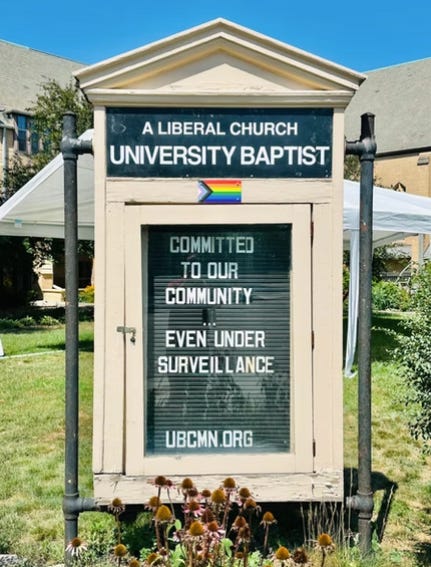
Federal agents have been entering American churches undercover.
Department of Homeland Security agents have entered Lutheran, Baptist, Episcopal, and Universalist church buildings in Minnesota and Michigan while tracking activists, secretly recording gatherings, and collecting information about people connected to them.
At University Baptist Church in Minneapolis, an undercover agent entered a class being held in the church gym wearing a concealed recording device. Federal records later revealed additional surveillance visits to the property, including on Sundays.
This despite the fact that University Baptist was already covered by a federal court injunction limiting warrantless immigration-enforcement activity at participating houses of worship. Eleven religious plaintiffs have now asked a court to hold the Department of Homeland Security in contempt. And on August 24, a federal judge ordered the government to explain why it should not be held in contempt for violating the injunction.
If you want to understand how this story came to light, follow Brian Kaylor’s pioneering reporting at A Public Witness and Word&Way. Brian dug through court filings and documented federal infiltration of church spaces before most national media noticed. NPR has now picked up the story, describing a much broader surveillance operation involving churches, community groups, libraries, labor organizations, and private communications.
This deserves far more attention than it has received, because it is not simply an immigration-enforcement story. It is a story about what happens when independent religious institutions become inconvenient to government power.
Something is stirring in Mainline Protestantism
Bishops are confronting presidents. Pastors are putting their bodies on the line. Denominations are drawing theological boundaries around Christian nationalism. Churches are suing the government to preserve their freedom to minister. Congregations are organizing networks of care for immigrant families living under threat.
Episcopal Bishop Mariann Budde stood feet from the newly inaugurated president and, in the name of God, asked him to have mercy on immigrants, LGBTQ children, and frightened families. Presbyterian pastor David Black stood outside an ICE detention facility near Chicago with his arms raised in prayer and was struck in the head with a pepper ball fired by federal immigration personnel.
This summer, the General Assembly of the Presbyterian Church (U.S.A.) overwhelmingly declared White Christian nationalism a “theological error” incompatible with the teachings of Jesus Christ and advanced a constitutional amendment opposing the use of state power to establish Christianity as privileged or dominant.
The political press treated conservative evangelicals as essentially the Protestant political story. But the resurgence of Mainline public witness and organizing could matter politically more than many people realize.
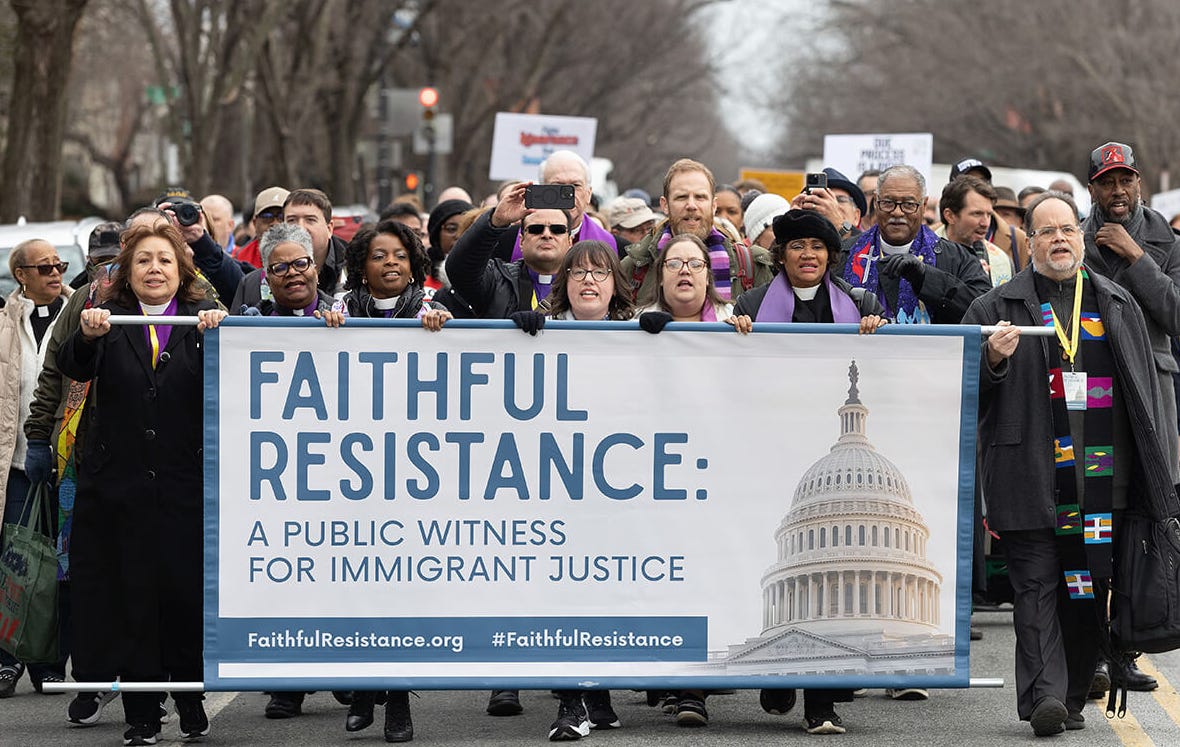
Lutheran pastors and bishops in Minnesota have refused to be deterred by immigration enforcement. More than 2,000 United Methodists and other people of faith filled churches on Capitol Hill and marched around the Capitol in a “Faithful Resistance” witness for immigrant justice. American Baptists have gone to court to protect congregations from government interference with worship and ministry.
This isn’t a case of Mainline Christians suddenly discovering justice in 2026. Mainline clergy, congregations, and denominations have been standing with immigrants, confronting racism, defending LGBTQ people, protecting voting rights, and challenging abuses of power for decades. What may be changing is the visibility, coordination, and urgency of that witness.
The political press treated conservative evangelicals as essentially the Protestant political story. But the resurgence of Mainline public witness and organizing could matter politically more than many people realize.
Political reporters: pay attention.
Mainliners are more politically important than the stereotype suggests
For years, “Mainline Protestant” has almost become shorthand for a fading religious establishment: aging congregations, shrinking membership, beautiful old buildings with fewer people inside them.
But something interesting is happening in Minnesota.
During the immigration-enforcement surge, Anoka United Church of Christ became a hub for mutual aid and community organizing. Pastor Chris McArdle told the Minnesota Star Tribune that at least 100 people new to the congregation began attending worship during or after the surge. About half have stayed, helping bring attendance to more than 300.
Some first encountered the church because it was helping its neighbors. Some had been away from Christianity for years.
One congregation does not constitute a national revival. But it suggests something worth watching: When churches become more relevant to their neighbors’ lives, people may begin to find religion relevant again.
When churches become more relevant to their neighbors' lives, people may begin to find religion relevant again.
And Mainline Protestants remain a larger constituency than the usual story of decline suggests. According to PRRI’s 2025 Census of American Religion, white Mainline/non-evangelical Protestants make up about 13 percent of the American population—the same share as white evangelical Protestants and slightly more than white Catholics.
Politically, they are not simply the religious wing of the Democratic Party. Pew finds that Mainline Protestants actually tilt Republican: 51 percent identify with or lean toward the Republican Party, compared with 41 percent toward Democrats. Evangelical Protestants, by contrast, are about 70 percent Republican or Republican-leaning.
That political heterogeneity is exactly what makes Mainline resurgence so important.
When a Mainline bishop, pastor, or congregation challenges unchecked government power, the audience can include Republicans, Democrats, and independents. People who may have voted for Trump but recoil when federal agents enter churches. People who favor stronger border enforcement but don’t believe government should decide whom the church may accompany. People who would never attend a protest but understand that a pastor ought to be able to minister without wondering whether someone in the room is wearing a wire.
There are signs of movement. PRRI found that favorable views of Trump’s handling of immigration among white Mainline/non-evangelical Protestants fell from 64 percent in March 2025 to 46 percent by March 2026. In another PRRI measure this spring, half of white Mainline Protestants described Trump as a potentially dangerous dictator whose power should be limited. Among white evangelicals, 68 percent instead described him as a strong leader who should be given the power he needs to restore America’s greatness.
This suggests that American religious politics are not neatly divided between a Christian Right and a secular Left. A large Christian constituency sits uneasily between those poles, and Mainline churches have institutions, relationships, and moral vocabularies that can reach them.
Christian nationalism has spent decades trying to persuade Americans that Christian is essentially synonymous with a particular form of conservative politics. An independent Mainline witness disrupts that monopoly. It insists that Christianity does not belong to any president or party.
And that is when churches can become troublesome to unchecked power.
The goal is to make religion submit.
The surveillance of churches belongs within a much larger pattern. Universities have faced funding freezes and political demands reaching into academic governance. Law firms have been targeted over clients and past cases. News organizations have faced lawsuits, subpoenas, and regulatory pressure. Nonprofits and foundations have confronted investigations, canceled grants, and threats to tax-exempt status.
The methods differ: freeze the money, threaten the institution, investigate the critic, punish the dissenter. Make independence costly enough that people begin censoring themselves.
Churches are part of that civil society ecosystem. We have buildings scattered across nearly every community in America. We gather people face-to-face. We move money and resources. We feed people, accompany families, visit prisoners, teach children, preach, pray, organize, and sometimes shelter frightened people. And at our best, we answer to something higher than the state.
That makes independent religious institutions enormously valuable to democracy. It can also make them enormously inconvenient to governments that would prefer fewer institutions capable of saying no.
For Christians, this independence isn’t simply a democratic safeguard. It is a theological necessity. The church must remain free precisely because sometimes faith requires us to challenge the abuse of power.
The church must remain free precisely because sometimes faith requires us to challenge the abuse of power.
This is why we need to know something about Hungary’s Viktor Orbán.
Orbán didn’t abolish Christianity. He captured it.
Hungary offers a warning because Viktor Orbán, like Trump, publicly elevated Christianity while favoring religious institutions aligned with his political project.
His government wrapped Hungarian national identity in Christian language and favored churches aligned with its political project. Public Christianity remained highly visible. But there was another side to the bargain.
Pastor Gábor Iványi, once personally close to Orbán, became an outspoken critic of his government’s treatment of refugees, poor people, and marginalized communities. After Orbán’s government rewrote Hungary’s religion law, Iványi’s Hungarian Evangelical Fellowship lost its recognized church status. The church and charitable network also faced raids, funding pressures, school closures, and criminal proceedings.
Authoritarian religious politics does not require the destruction of religion. It can capture religion: reward institutions that legitimate political power, punish or weaken those that challenge it, cultivate favored religious leaders, and make prophetic independence increasingly expensive.
Eventually, nobody has to tell religious leaders to stay quiet. They learn.
As Holly Berkley Fletcher reported in The Bulwark, Samaritan’s Purse is set to receive roughly $300 million over two years under the Trump administration’s new foreign-aid structure, while historically Mainline and ecumenical organizations such as Church World Service and Lutheran World Relief received no funding.
That does not prove organizations were chosen or excluded because of their politics. But it should make us pay attention. Church World Service and its member denominations have been highly visible in defending immigrants and opposing mass deportation. Franklin Graham has been among Trump’s most loyal religious defenders.
The question isn’t whether Samaritan’s Purse does valuable humanitarian work. The question is what kind of religious ecosystem government policy creates when enormous resources flow toward religious institutions friendly to power while independent religious institutions face surveillance, investigation, litigation, and financial pressure. You can end up with a government that talks constantly about Christianity while punishing Christians who refuse to bend the gospel to political power.
You can end up with a government that talks constantly about Christianity while punishing Christians who refuse to bend the gospel to political power.
That is the danger, and it points toward the spiritual task before us.
This is our spiritual practice now
Authoritarian movements run on fear. Fear tells us to contract: protect yourself, circle the wagons, distrust the stranger, don’t make trouble, keep your head down.
Christian spiritual practice moves in the opposite direction. Jesus keeps moving toward people—toward the sick, toward the outsider, toward the person respectable society has decided is expendable, and eventually toward Jerusalem itself, despite knowing the consequences of confronting religious and imperial power there.
So perhaps one spiritual practice for this moment is very simple:
Notice where fear is asking you to withdraw from another human being—and move toward them instead.
Not everyone has to become a professional activist. Moving toward someone might mean making a phone call, bringing groceries, learning the name of the immigrant family worshiping down the pew, showing up when clergy gather, supporting the congregation taking a risk, giving money, driving someone to court, or praying beside someone who is afraid.
Courage rarely begins with feeling fearless. Often it begins by deciding that fear will not determine the distance between us and our neighbor.
And perhaps nowhere is that clearer right now than Springfield, Ohio.
Springfield shows us what an inconvenient church looks like
Religion News Service recently reported on churches in Springfield preparing for the possibility that Haitian parents will be detained and separated from their children.
More than 10,000 Haitians live in this Ohio community. As immigration enforcement intensifies, some people have become frightened to leave their homes. Parents are completing power-of-attorney documents so someone can care for their children if they are detained. Churches and faith-connected volunteers are delivering food and diapers, providing rides to immigration court, finding lawyers, and building networks of families willing to step in when someone disappears into detention.
Think about what that means.
Church families are preparing to take children into their homes if the government takes their parents.
That is not an abstract theological statement about welcoming the stranger. That is somebody clearing out a bedroom, buying more cereal, figuring out school pickup, taking responsibility for a frightened child.
Pastor Carl Ruby of Central Christian Church has been standing with Springfield’s Haitian community for some time. When Haitian immigrants were ordered to report to an ICE office near Cincinnati—where many were fitted with electronic ankle monitors—Ruby and other faith leaders accompanied them.
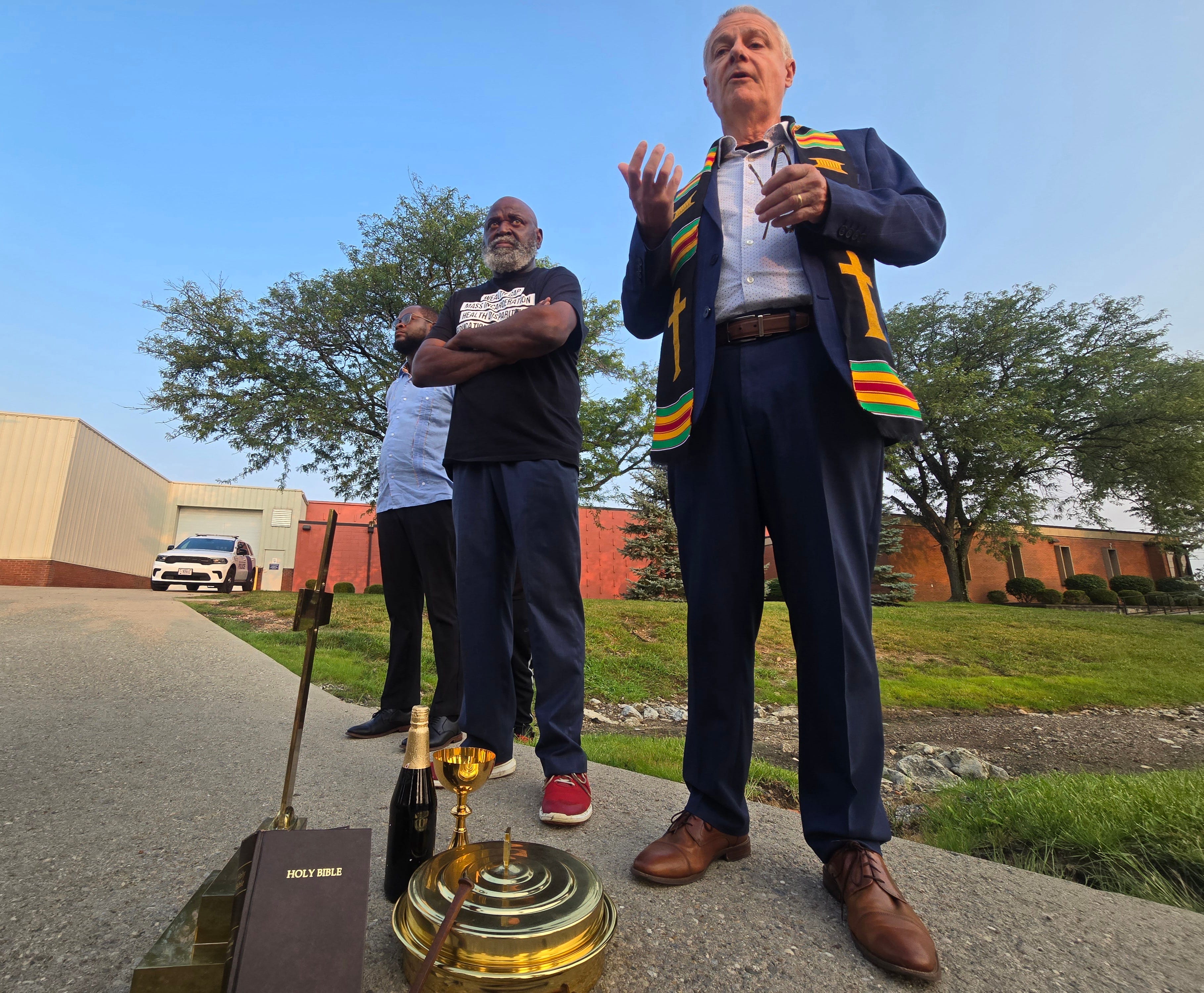
Outside the ICE office, they served communion. Ruby offered the bread and cup as a reminder that these Haitians remained part of the body of Christ.
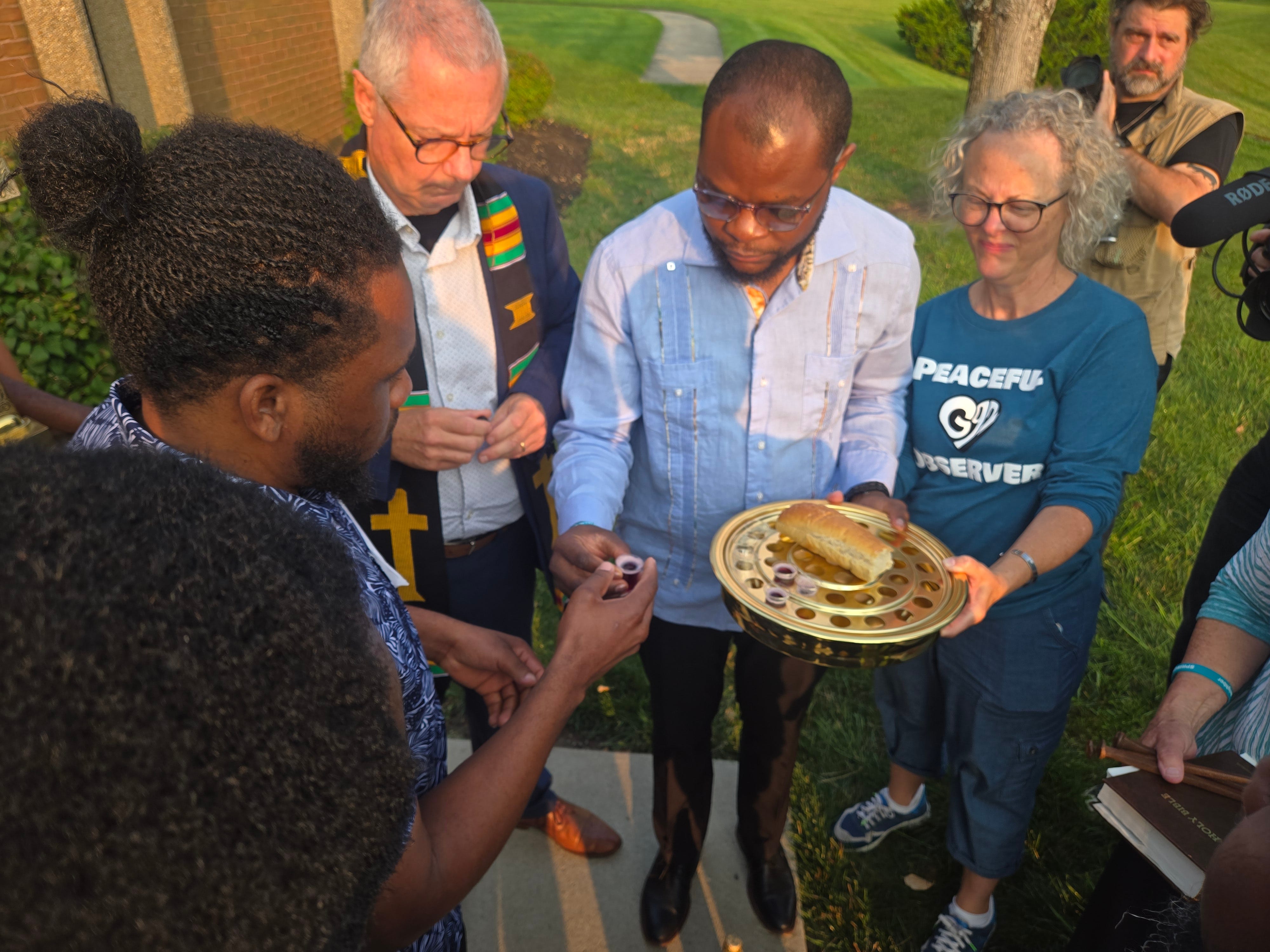
I can’t stop thinking about that image.
The state puts a monitor around your ankle.
The church places bread in your hand and says, “You are part of the body.”
One system marks a person for surveillance. Another insists upon belonging. That is the crux of Christian teaching.
And it may explain why churches become so inconvenient to abusive power when they become indispensable to their neighbors. When someone loses the right to work, the church brings groceries. When parents fear being taken away, the church finds someone to care for their children. When somebody has to walk into an ICE office alone, the church shows up with communion.
This is what independent religion can do. A government can degrade, but we can dignify. And we can insist that no government gets to overrule the church’s command to love our neighbors and welcome the stranger.
Maybe being inconvenient is part of our vocation
The Hebrew prophets were terribly inconvenient. Moses was inconvenient to Pharaoh. Jesus was inconvenient to religious and political authorities who had learned to live quite comfortably with one another. The early church’s insistence that Caesar was not Lord was not exactly helpful to the imperial public-relations strategy. Faith at its best has always created people who know there are things they cannot worship, bargains they cannot make, and neighbors they cannot abandon.
Faith at its best has always created people who know there are things they cannot worship, bargains they cannot make, and neighbors they cannot abandon.
An independent church can refuse to have its silence purchased with access or funding. It can refuse to baptize cruelty by surrounding it with Christian language, or turn fear into theology and call it faithfulness. It can insist that human dignity does not depend upon the permission of the state.
And it can certainly become inconvenient when politicians claim Christianity for themselves and then discover that Christians intend to behave like Christians.
For years, Christian nationalism has tried to convince America that Christianity belongs naturally alongside domination, exclusion, and political power. That is a lie.
There is a much older faith available to us: a faith of Exodus and liberation, of prophets confronting kings, of Jesus announcing good news to the poor and freedom to the oppressed, of disciples discovering that love is stronger than empire, and of communities learning to care for one another when the powers around them will not.
That faith is not gone. I think we can see it becoming more visible.
We see it when a bishop asks a president for mercy; when a Presbyterian pastor keeps praying as pepper balls fly; when a denomination says Christian nationalism is incompatible with the teachings of Jesus; when Baptists go to court rather than surrender the independence of their churches; and when federal agents enter churches and churches refuse to be intimidated into silence.
And we see it in Anoka, where people encountered a church serving its neighbors and decided to come through its doors.
We see it in Springfield, where Christians are working out who will take the children, bring the diapers, make the drive—and carry communion to people walking into an ICE office.
Mainline churches may never again possess the institutional dominance they once enjoyed. I am increasingly convinced that isn’t the interesting question anyway.
Perhaps the church is finding something better than dominance: its voice, its courage, its capacity to love its neighbors without asking permission.
And if you’re looking for a spiritual practice this week, find one place where somebody is courageously standing for justice and stand a little closer to them.
Maybe bring some bread.
Maybe that is how courage grows. Maybe that is how movements grow.
And maybe becoming a little inconvenient is exactly what faithfulness requires of us now.
If this kind of independent faith-rooted analysis matters to you, I hope you’ll consider becoming a paid subscriber.
I write Reclaim Faith to help us understand what is happening to religion and democracy—and to lift up the people and communities showing us another way.
Paid subscriptions make this work possible and help me keep more of it available to everyone.
Subscribe, support the work, and help reclaim faith for justice.
So many good points. Mainline churches are an embedded part of the community—-food shelter and resources— they do make it “inconvenient” for abusers of power and authoritarianism. Because people trust churches who feed and give shelter.
I see this happening where I am, too. Gives me hope and courage in a time where holding on to hope can feel difficult. Appreciate your work.